In the precision-driven world of hydraulic systems, the total cost of ownership is rarely defined by the initial hydraulic seal kit price, but rather by the operational longevity and failure rates of the seals used. As industrial machinery pushes toward higher pressure thresholds, the demand for advanced elastomer compounds and reinforced skeletons has shifted the pricing landscape from commodity-based to performance-based.
This shift is critical for engineers in mining, construction, and automotive sectors, where a single seal failure can result in catastrophic downtime and expensive fluid loss. The technical challenge lies in balancing material compatibility—such as the choice between NBR and FKM—against the extreme pressure and thermal stresses encountered in heavy-duty applications.
This analysis examines the engineering variables that influence procurement costs and explores how selecting the correct technical specifications can mitigate long-term operational risks. By understanding the relationship between material science and system pressure, procurement teams can better evaluate the value proposition of high-performance sealing solutions.

The Engineering Logic of Sealing Systems

The primary function of a hydraulic seal is to prevent the leakage of pressurized fluids while excluding external contaminants. This requires a precise balance between the seal's hardness, the elasticity of the elastomer, and the structural integrity of the metal casing.
When evaluating the cost of these components, the focus must be on the "sealing interface." A high-pressure oil seal must maintain a constant contact pressure against the shaft, even as the material undergoes thermal expansion or compression under load.
Material Influence on Performance and Cost
Material selection is the most significant driver of the base cost. Nitrile Butadiene Rubber (NBR) serves as the industry standard for general-purpose applications due to its excellent oil resistance and cost-effectiveness. However, NBR has limitations in extreme temperature environments, which often leads engineers to specify FKM (Fluorocarbon) for high-stress systems.
FKM provides superior chemical resistance and can withstand significantly higher temperatures than NBR. This material upgrade increases the initial cost but reduces the frequency of replacement cycles. In environments where seals are exposed to aggressive synthetic fluids or high-heat cycles, the use of FKM becomes a technical necessity rather than a preference.
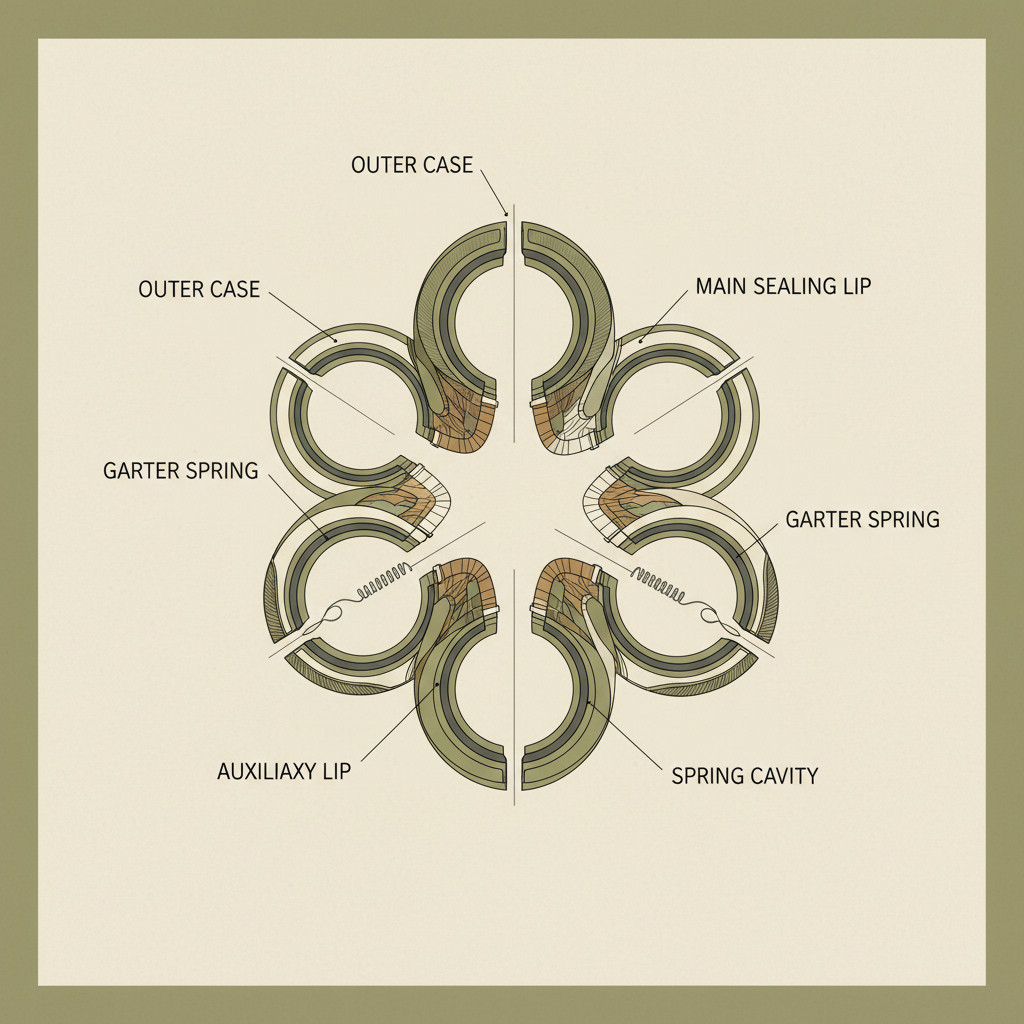
Beyond the elastomer, the inclusion of a metal ring—common in high-pressure skeleton seals—adds structural rigidity. This prevents the seal from extruding into the gap between the shaft and the housing under extreme pressures, such as the 0.98MPa resistance found in specialized TCN oil seals.
High-Pressure Resistance and Skeleton Design
Standard seals often fail in high-pressure hydraulic circuits because the elastomer simply cannot resist the force of the fluid, leading to "seal blow-out" or permanent deformation. To solve this, the skeleton seal architecture incorporates a reinforced metal frame.
From a procurement perspective, the "price" of a seal kit is effectively a proxy for its pressure rating and material grade. A kit designed for 0.5MPa will naturally cost less than one rated for near-1MPa, as the latter requires tighter manufacturing tolerances and higher-grade metal components.
Comparative Value of Material Grades
When analyzing the value of different seal materials, it is helpful to use a normalized engineering assessment. This helps buyers understand where they are paying for "over-specification" versus where they are risking "under-specification."
The following data represents a relative assessment of material performance across key industrial dimensions: temperature stability, chemical resistance, wear rate, and pressure handling.
Normalized Engineering Assessment by Material
Typical Deployment Scenarios in Heavy Machinery
In concrete mixer trucks and mining excavators, seals are exposed to a combination of abrasive dust and high-pressure hydraulic oil. In these representative engineering scenarios, a "Dust Oil Seal" is often paired with a high-pressure internal seal to create a dual-barrier system. This configuration prevents external particulates from reaching the primary sealing lip, thereby extending the service life of the kit.
For automotive wheel hubs and heavy-duty axles, the focus shifts toward dynamic sealing. The seal must maintain a leak-proof barrier while the shaft rotates at high speeds. In these cases, the choice of a high-quality rubber compound with a reinforced metal ring is essential to prevent heat build-up and premature wear, which would otherwise lead to frequent and costly maintenance intervals.
Future Trends in High-Pressure Elastomers
The industry is moving toward "intelligent" material blends that combine the oil resistance of NBR with the thermal stability of FKM. These hybrid elastomers aim to provide a middle-ground solution that offers higher reliability than standard NBR without the steep cost increase associated with pure FKM.
Furthermore, there is an increasing focus on reducing the friction coefficient of the sealing lip. By implementing advanced surface treatments or incorporating PTFE (Polytetrafluoroethylene) layers, manufacturers can reduce the heat generated by friction, which is a primary cause of seal degradation in high-speed hydraulic systems.
Precision manufacturing is also evolving. With the adoption of more precise instruments and ISO9001 standards, the tolerance for seal dimensions has tightened. This ensures a more consistent fit, reducing the likelihood of installation-induced damage and ensuring that the rated pressure resistance is achieved in every unit.
Selection Matrix for Hydraulic Components
Selecting the right seal kit requires a systematic comparison of the operating environment against the material capabilities. A mismatch—such as using NBR in a high-temperature environment—will result in rapid material hardening and failure, regardless of the initial purchase price.
The following table provides a technical comparison of different configuration profiles. It is designed to guide procurement teams in matching their specific application requirements to the appropriate seal architecture.
By utilizing this framework, engineers can justify the investment in higher-grade materials by demonstrating the reduction in expected downtime and the increase in mean time between failures (MTBF).
| Configuration Type | Primary Material | Pressure Rating | Recommended Use Case |
|---|---|---|---|
| Basic Profile | NBR | Low-Medium | General Industrial/Low Heat |
| Standard Duty | NBR + Metal Ring | Medium | Standard Hydraulic Cylinders |
| High-Duty Profile | FKM / FPM | High (0.98MPa) | Mining & Heavy Construction |
| Precision Profile | Custom Blend | High Precision | Automotive/High-Speed Axles |
| Extreme Temp Profile | Fluorocarbon | Variable | Oilfield/High-Heat Processing |
| Industrial Baseline | Mixed Rubber | Low | Static Sealing/Dust Protection |
Technical FAQ
The price is primarily driven by material composition (e.g., NBR vs. FKM), the inclusion of structural reinforcements like metal rings for high-pressure resistance, and the manufacturing tolerances required for the specific application. Higher pressure ratings, such as those exceeding 0.9MPa, typically require more expensive materials and precise machining to prevent extrusion.
The decision depends on the operating temperature and the type of fluid used. NBR is suitable for standard mineral oils at moderate temperatures. If your system operates at extreme temperatures or uses aggressive synthetic fluids that degrade standard rubber, FKM is required. FKM provides significantly higher thermal stability and chemical resistance, though at a higher cost.
A metal ring provides a skeleton that prevents the elastomer from deforming or extruding under high hydraulic pressure. This allows the seal to maintain its shape and sealing contact against the shaft even under loads of 0.98MPa or higher. Without this reinforcement, the rubber would likely be forced into the clearance gap, leading to immediate leakage.
Analyze the failure pattern: hardening indicates thermal overload (suggesting a move to FKM), while "nibbling" or extrusion indicates pressure overload (suggesting a reinforced skeleton seal). If the seal is contaminated with grit, the issue is likely a failure of the external dust seal rather than the hydraulic seal itself.
Yes, professional manufacturers often provide customized dimensions beyond the standard size catalog. This is essential for legacy machinery or specialized engineering projects where OEM parts are unavailable. Customization typically involves specifying the exact inner diameter, outer diameter, and thickness, along with the required material grade.
Minimum Order Quantities (MOQ) vary by supplier and customization level. For standard catalog items, MOQs can be as low as 20 pieces, whereas fully customized specifications may require larger batches to offset the tooling and setup costs associated with precision rubber molding.
Engineering Implications for Procurement
The analysis reveals that the most cost-effective approach to managing hydraulic seal kit price is to shift focus from the unit cost to the lifecycle cost. By correctly matching material grades (NBR vs. FKM) and structural reinforcements (skeleton designs) to the actual pressure and temperature constraints of the system, operators can significantly reduce downtime.
Ultimately, the investment in high-pressure resistant seals, such as those rated for 0.98MPa, is an insurance policy against the far greater costs of system failure and unplanned maintenance. For those managing heavy-duty fleets in mining or construction, prioritizing technical specifications over the lowest initial bid is the only sustainable engineering strategy.